
Quick Links
Course Details
Continuing the positive experience from the last semesters, we have decided to offer the course Internet Transport in a format that considers the possibility for as well students as lecturer and tutors to give and / or consume parts of the course online using webconference tools.
Important: The course will be given synchronously, i.e. participation is live either in presence or online. An interactive manuscript will support preparation and reworking but cannot replace participation. We strongly encourage personal presence in the units.
Remark:
The course Internet Transport is a revised and updated version of the courses Media Transport resp. Future Media Internet.
Hence in case you already successfully passed an earlier version you cannot gain credit points anew!
Introduction
More than 20 years ago researchers observed distruptive changes in network and service architectures: Everything over IP, IP over Everything, inspired by the push of telephone companies towards Voice over IP, created the vision of a unified network and service architecture. The core observation has been that the internet—represented by its core-protocols, i.e. IP on the so-called network layer and TCP on the so-called transport layer—can be run over nearly all physical media (IP over Everything (IPoE)) and in addition can be used to carry any form of data imaginable: texts, images, graphics but also media like voice, radio or television (Everything over IP (EoIP)).
The course Internet Transport will introduce the requirements for the transport of media and other time-critical data over the Internet, introduce proper channel models, calculate the channel capacity of those channels and derive a framework for optimised media transport. We will look into both domains, the time and the reliability domain, showing that they partially contradict each other and that the transport—supported and partially enabled by the lower and the higher layers—needs to be rethought to fullfill the requirements of EoIP/IPoE. Besides giving an overview over recent specifications and standards (TSN, DASH) the course will introduce latest research results on predictably reliable transport protocols.
Prerequisites
Digital Transmission & Signal Processing as well as Audio/Visual Communications and Networks are recommended for this course. Students with solid background in Computer Networks and Error Correction, however, are also encouraged to participate.
Course Structure
Basic Rules
- Please note that small changes and corrections will be applied to the lecture notes throughout the semester. If you find mistakes or have suggestions how to enhance the lecture notes we appreciate your input!
- Please don’t hesitate to tell us if you have any comments or suggestions related to lecture notes, task sheets, exercises or even organizational things. We will improve it soon so you can benefit from it, not only future students.
Lectures
- The lecture will be offered in a hybrid format (classroom plus remote participation via MS Teams). Under special circumstances it might be advantageous or even required to omit the classroom and switch to fully remote. This will be announced on time.
- MS Teams: IT SS 2026 Team (send a join request for remote participation)
- Place: Campus C6.3, Room: 9.05
- Time: Tuesday 14:30–15:45 and Wednesday 12:15–13:45 (start April 7th)
Tutorials
- Moodle: IT (SS26) (enrol to access quizzes and assignments)
- Place: Campus C6.3, Room: 9.05 (presence)
- Time: Wednesday 14:15–15:45
- Tutor: Marlene Böhmer & Moritz Miodek
Quizzes
- Weekly Moodle quizzes with 15 minutes for 5 questions within the time below.
- Place: Lecture room (or online via Moodle)
- Time: Tuesday 14:00–14:30
Task Sheets
- Task sheets are published on the day succeeding the tutorials in Moodle.
- You submit your solution and work on the tasks up to and including the following tutorial.
- During the tutorial you can discuss and evolve your solutions.
Exam Dates
- The exams will be held as ORAL exams. How you can choose a certain exam slot will be announced on time.
- Main Exam: July 27th–29th, Place: C6 3 10.02, slot allocation via Moodle
- Re-Exam: September 21st–23rd, Place: C6 3 10.02, slot allocation via Moodle
Exam Eligibility
- We will check attendance in the lectures. You need to collect 50% attendance points, with personal presence accounting for 1 point and hybrid participation accounting for 0.5 point.
- The weekly quizzes and task sheets for this course will be divided into two parts, blocks A&B containing 6 quizzes and 6 task sheets each.
- You need a minimum of 19.2 points (40%) of the 48 points achievable in a block to pass a block. (Each quiz is worth 5 points and each task sheet is worth 3 points.)
- You must pass attendance and both block A and B to be eligible for the exam.
Matlab
- UdS has a MATLAB campus license which can be used by all university students for non-commercial purposes.
Literature
- Ramjee Prasad, Marina Ruggieri: "Technology Trends in Wireless Communications", Artech House Publishers, 2003, ISBN = {1-58053-352-3}
- Mihaela van der Schaar, Philip A. Chou: "Multimedia over IP and wireless networks: compression, networking, and systems", Academic Press, 2007, ISBN = {0-12088-480-1}
- DozentIn: Marlene Böhmer
- DozentIn: Thorsten Herfet
Introduction
Large-scale networks as the Internet are crucial for day-to-day communication and nowadays affect all areas of life. In parallel, near-field communication and personal area networks are becoming increasingly important for connecting the digital with the physical world and in particular an individual's health. Building and harnessing these communication systems requires in-depth understanding and practical experience on the concepts of networking as well as network programming and troubleshooting methods. Starting from the application layer, all important parts and components of networks are explained, down to some of the physical aspects of wired and wireless technology. Most importantly, these considerations are not only done in theory but are accompanied with hands-on labs, to apply the learned concepts in practical scenarios.
The Telecommunications Lab at Saarland University is offering this course to teach networking fundamentals to undergraduates, as these topics are not part of the mandatory curriculum in Computer Science Bachelor program.
Curriculum
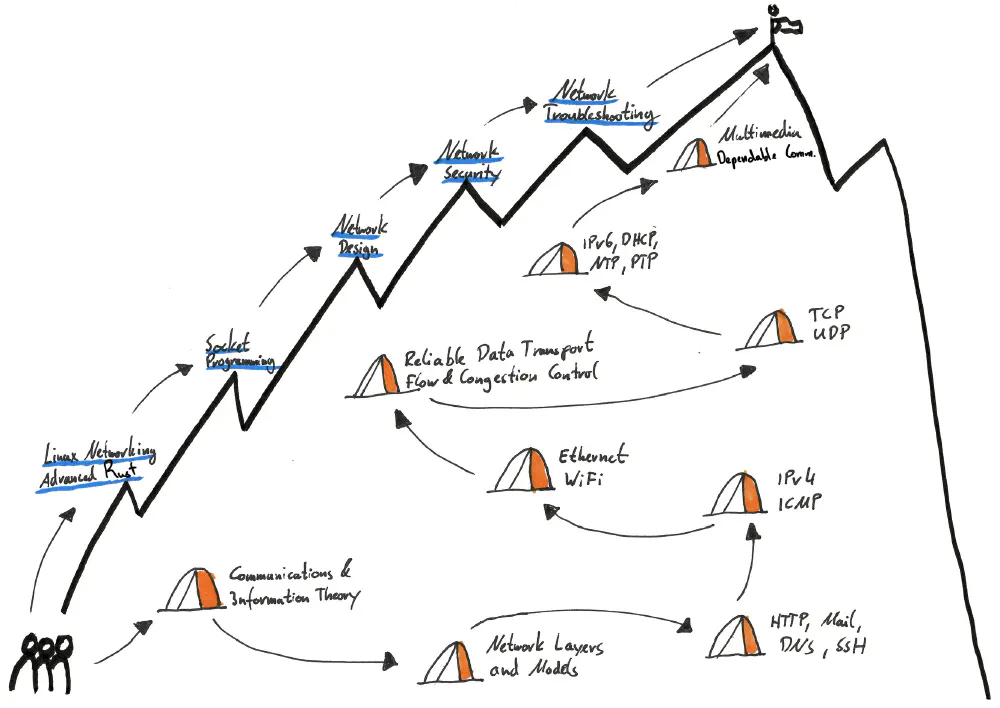
The course covers four major areas, giving you practical and theoretical knowledge to create, maintain and advance network environments, which are essential for today's fully-connected world. The following questions (among others) will be answered in this course:
- Foundations of Communication and Networking.
- What are buffers and queues for, why do you need sequence numbers and what is the advantage of push over pull?
- Why are forwarding and routing not the same and what makes a hub different from a switch?
- Top-down Tour through the ISO/OSI Model.
- How do applications, such as HTTP and Email, use the Internet as a communication infrastructure, e.g. using TCP or UDP connections?
- How are packets forwarded across a cable, a sub-network and even across the Internet itself?
- Designing and Troubleshooting Small Networks.
- How to use WireShark for network analysis and GNS3 for network simulation?
- How can I write my own firewall rules and fix misconfigurations in a network?
- Development of Network Applications.
- How to write server and client applications for the next exciting Internet application?
- How to modify data streams to ensure reliable transmission over unreliable networks?
Organization
- Credit Points: 6 (ungraded, except for Systems Engineering students)
- Format: Lab (Praktikum)
- Audience:
- Bachelor Students (typically in 3rd semester or higher, highly motivated 1st semester are also welcome).
- If you are a Master Student you can still participate, but as you might have attended the "Data Networks" core lecture or a similar course at another university, large parts of the theory we cover are not going to be new for you.
- Schedule:
- 2 weeks presence time (23rd Feb. – 06th Mar. 2026)
- Time: 8:30 – 15:00 (lunch break roughly 12:00 – 13:00 and shorter breaks as schedule permits)
- Room: E1 3 HS001
- 2 weeks for implementing small networking projects (09th Mar. – 22nd Mar. 2026)
- a small exam on April 14th
- Time: 16:00 – 17:00
- Room: E2 2 GHH
- a re-exam on May 19th
- Time: 11:00 – 13:00
- Room: C6 3 9.05
- All the dates can be found here (as soon as they are fixed).
- 2 weeks presence time (23rd Feb. – 06th Mar. 2026)
- Language:
- Lectures, Slides, Task Sheets, etc. in English.
- Some instructors and tutors speak German so no problem if you don't understand something (bei Problemen: Fragen!)
- Requisites:
- Enough motivation and drive for taking part in a short but intensive course with many new concepts.
- No prior networking knowledge required.
- Elementary programming skills required (e.g. Programmierung 2, Programmieren für Ingenieure).
- Rust skills are beneficial, but there will be tutorials on that.
- This is not an open course, admission is needed (see below).
Admission
In order to ensure that you fulfill the requirements for this course and be able to keep with the fast pace, there is an admission test before the course starts. This is to ensure that you are not disappointed when putting a lot of effort (and free time in the semester break) into a course where you cannot keep up. Furthermore, this shows that you are dedicated and take the course seriously, which is needed for a short and intensive course as this one.
- Date: 28th January 2026, 16:30
- Place: E2.2 Günter-Hotz Lecture Hall
- Duration: 30 minutes
- Topics: Boolean Algebra, Bits and Bytes, Programming (a mock test can be found under materials)
Please register for this course if you want to take part in the admission. If you just stop by, there is NO guarantee that we have a booklet for you!
- DozentIn: Thorsten Herfet
- DozentIn: Ishwar Mudraje
- DozentIn: Kai Vogelgesang