
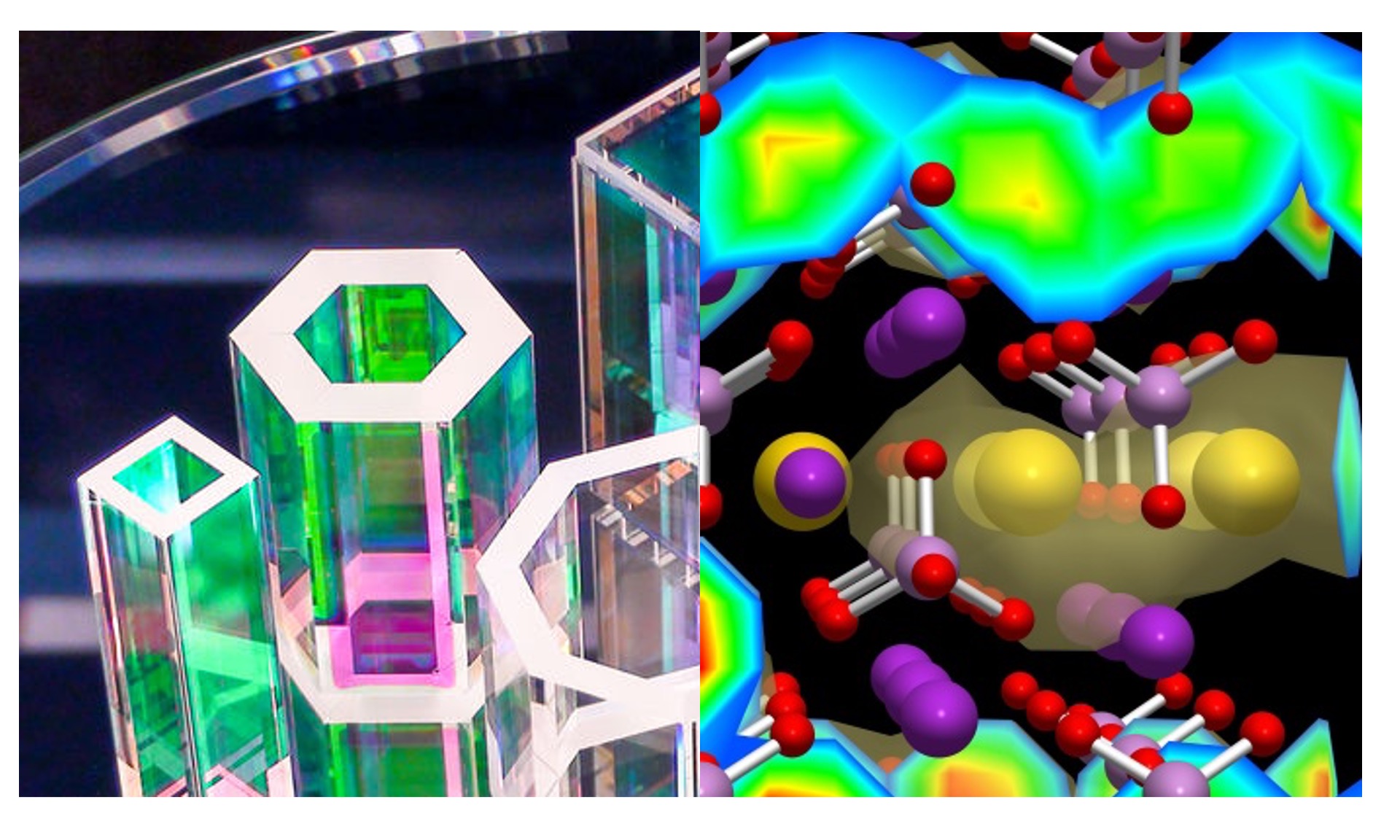
Understanding glass and ceramic materials is based on a broad foundation of fundamental knowledge of solid state chemistry and physics. This begins with chemical bonding and the structures of ceramics and glass materials. The path from raw material to the final product is determined, on the one hand, by powder technology processing of ceramics, on the other, by glass melting and refining techniques.
Important fundamentals of chemistry of glass and ceramic materials combined with processing techniques enable the understanding of microstructure-property correlations. Mechanical, thermal, dielectric, electrical and optical properties of inorganic-nonmetallic materials will be studied in more detail in the second part of the lecture.
The following content is covered in detail:
- Timeline of ceramic and glass materials, definitions of glass and ceramic materials, classification of glass and ceramic materials, glass and ceramic applications
- Structural chemistry of silicate ceramics, silica polymorphs, structure of oxide and non-oxide ceramics, structure of alumina, zirconia, titania, structure of carbides and nitrides
- Glassy state, V-T-Diagram, pair distribution function, diffraction methods and glass structure, theories of glass formation, nucleation and crystallization in glass
- Ceramic process engineering and technology, raw materials processing, colloidal dispersions and suspensions, rheology, shaping, drying, sintering
- Glass production processes and technologies, raw materials, glass melting furnace types, melting and refining, glass shaping, flat glass shaping, glass annealing, glass tempering
- Microstructure of glass and ceramic materials, definition of microstructure, process parameters influencing microstructure, ceramography
- Mechanical properties, strength, toughness and microstructure, fracture mechanic concepts, fractographic analysis, fracture statistics, toughening
- Thermal properties, heat capacity, thermal expansion, thermal conductivity, thermal shock resistance and surface tension, Hasselmann equations
- Dielectric properties of ceramics, polarization mechanisms, dielectric strength, ferroelectricity, ceramic capacitors, piezoelectricity, pyroelectricity
- Electrical properties, conduction mechanisms, electron energy bands, electron mobility, metal-like conductivity, semiconducting ceramics, ion conductivity, superconductivity, photoconductivity, photovoltaics, conductivity of specific glass compositions
- Optical properties, refractive index, chromatic dispersion, absorption and transmission, refraction, reflection, transparency, optical loss, scattering, translucent ceramics, solid state lasers, electrooptic ceramics
- Colored glass, spectrum of light, chromaticity, coloring principles and processes, structural aspects of glass coloring.
[Self-registration for the lecture is done using the ID #GL_Cer_2026#]
- Dozent: PD Guio Falk: Guido Falk